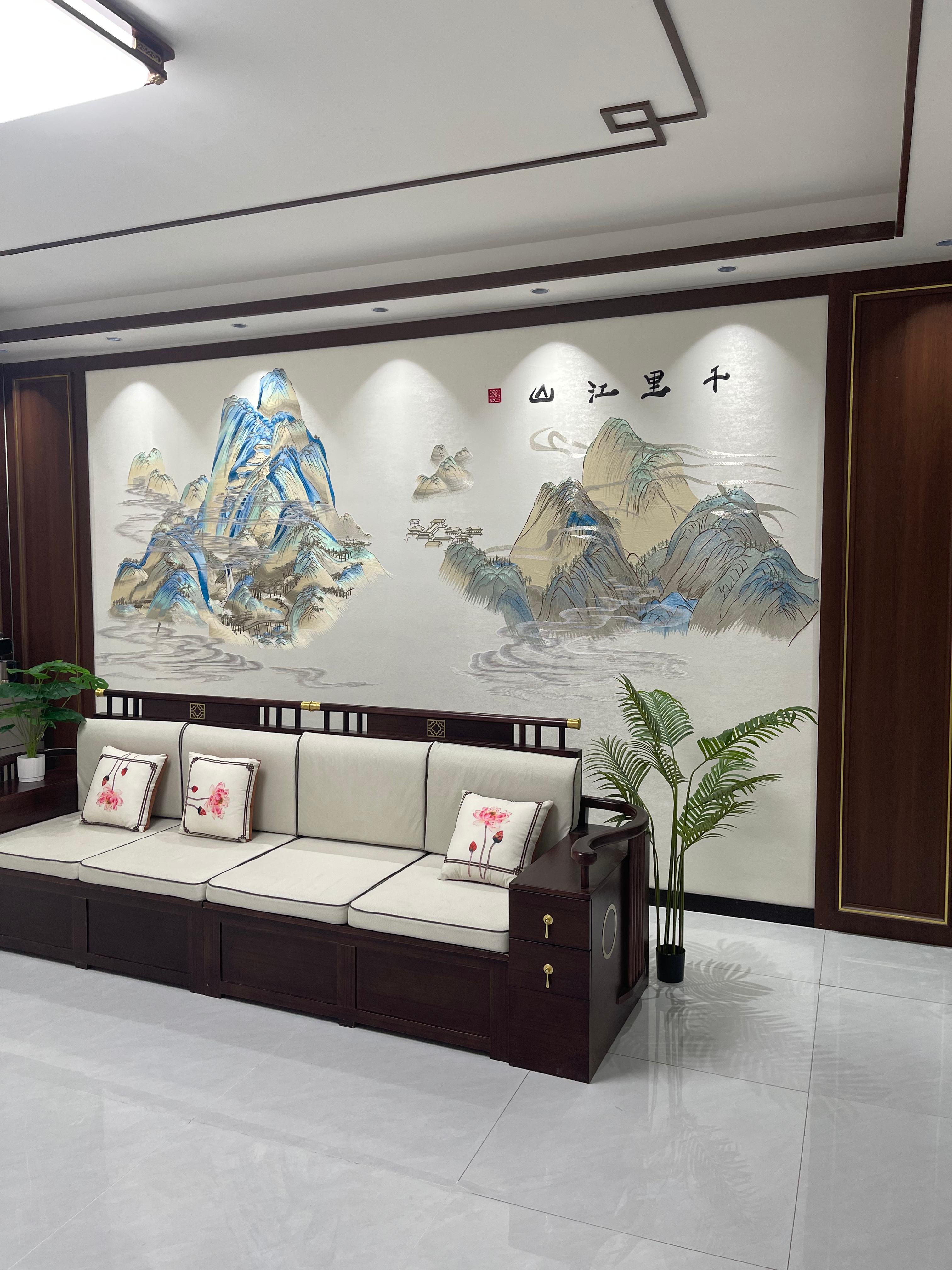
Buyers comparing wall coverings online usually look at the same thing: a flat photo. In a flat photo an embroidered mural and a printed one look almost identical. The difference only appears when you stand in front of the wall, or when light crosses it at an angle.
1. Texture you can feel with your hand
A printed mural is flat by definition — the ink sits inside the substrate. An embroidered mural is raised. Every contour line, every mountain ridge, every bird's feather is built from thousands of stitches standing a fraction of a millimetre above the base cloth. Run your hand across it and you feel the relief.
This is also why embroidery photographs badly and looks better in person. A camera sensor flattens depth. The wall does not.
2. How they behave under light
Printed colour is absorbed. Embroidery thread is a cylinder of polyester with a sheen, so it reflects. In a room with a reading lamp, a picture light or late-afternoon sun, the raised stitches catch highlights while the base cloth stays matte. The mural gains a second layer of depth that print cannot imitate.
3. Durability and cleaning
Printed wallcoverings can fade under sustained UV, and cheap ones show pinholes or seam lift within a few years. Embroidered murals use high-strength polyester thread on a warp-knitted polyester base — the same family of material as outdoor awning fabric. Colour fastness to water and perspiration on our panels is rated grade 4 to 5 against a standard of 3, and dry rubbing is grade 4.
Cleaning is simple: vacuum on low with a brush head, or wipe gently with a barely damp white cloth. Do not use bleach or alkaline cleaners.
4. Where print still wins
- Photographic murals — a real photograph of a skyline or a portrait cannot be stitched.
- Very tight budgets on large areas.
- Temporary spaces — rental fit-outs, event backdrops, seasonal displays.
If your project is a permanent feature wall in a home, a hotel lobby or a restaurant private room, embroidery is usually the right answer.
5. Price, honestly
Embroidery costs more than print — typically two to four times for the same area, depending on stitch density. Because every mural is made to your exact dimensions, the final quote depends on three variables: total area, stitch count per square metre, and pattern complexity. Send us your wall size and we will quote within 24 hours.
Frequently asked questions
Is an embroidered wall mural the same as a tapestry?
No. A tapestry is a hanging textile, usually woven and displayed on a rod. An embroidered wall mural is wallcovering — it is installed onto the wall with standard wallpaper adhesive, like premium wallpaper.
Can an embroidered mural be washed?
Spot-clean with a barely damp cloth. Full immersion washing is not recommended, as it can relax the embroidery tension. In practice the polyester thread resists staining well and rarely needs washing.
How long does an embroidered mural last?
With indoor use away from direct sustained sunlight, polyester embroidery wallcovering commonly lasts ten years or more without visible degradation. We have seen domestic installations past fifteen years.