Most buyers never see behind an embroidered mural, so lead times and pricing can look arbitrary. They are not. Here is the actual sequence, in the order it happens on our floor.
1. The stitch card — the mould of embroidery
Before any machine runs, the design exists as a stitch card: a program that tells the machine the exact coordinate, sequence, thread colour and stitch type of every single needle penetration. Digitising an image into a stitch card is skilled work — it is where an amateur file and a professional one diverge most.
We hold close to ten thousand stitch cards in house. For roughly ninety percent of orders the card already exists, so there is no card-making fee and production can start immediately. A genuinely new design adds about five to seven days. The fee is one-time — reruns of the same pattern cost nothing extra.
2. Dedicated single-embroidery machines
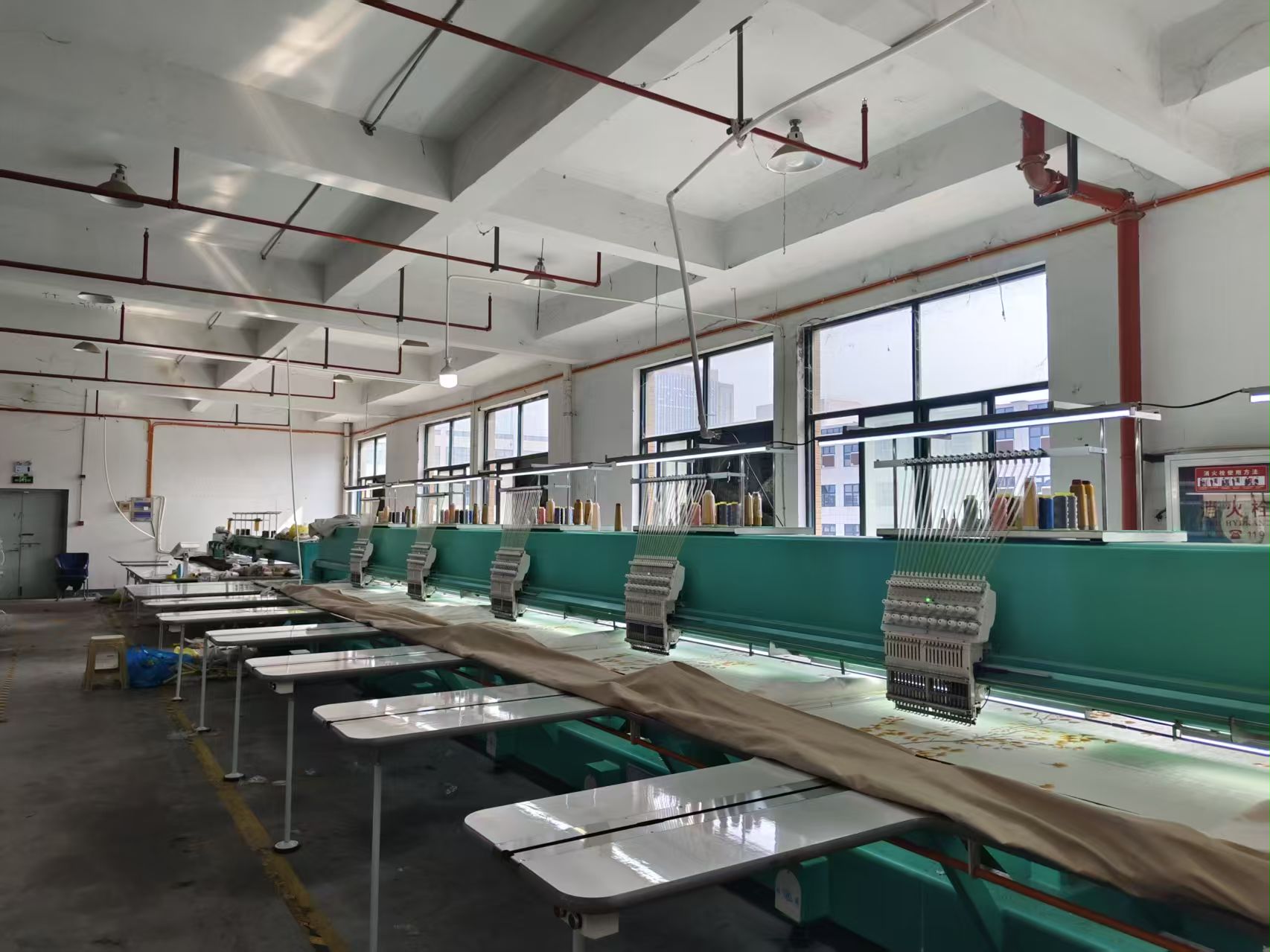
This is the part that surprises people. Most competitive suppliers run multi-head batch machines — efficient, but shared across many identical panels at once. We run dedicated single-embroidery machines: one head, one panel, one operator watching it. Slower per unit, far finer in detail, and the only practical way to hold true made-to-order sizing without a minimum order.
3. Scaling and the proof
Once you send your wall dimensions, we scale the composition to your aspect ratio and issue a proof. This is the checkpoint that prevents expensive mistakes: at this stage you can shift the focal point, change thread colours to match a paint sample or a sofa, and adjust the border. Nothing is stitched until you approve.
4. Embroidery
The card is loaded, the base cloth is tensioned, and the machine runs. A dense landscape at standard density takes several days of continuous running. Operators check thread tension and breakage several times a shift.
5. Quality check, cutting and packing
Every panel is inspected against the proof under even light — skipped stitches, tension drift and colour mismatch are all rejectable faults. Approved panels are trimmed, edge-finished, rolled face-inward onto a tube and packed into a hard carton with end caps. We ship rolled, never folded: a fold line in embroidery does not fully recover.
Typical timeline
- Catalog pattern, standard size: proof one to two days, production seven to fifteen days after approval.
- Custom design: add five to seven days for card-making.
- Express air freight: four to seven days transit. Sea freight to the Middle East and Southeast Asia: fifteen to twenty-five days.
Frequently asked questions
What file do I need to send for a custom design?
A high-resolution image — 300 dpi at final size is ideal, but we can often work with less. AI, PSD, TIFF and high-quality JPEG all work. If you only have a small photo, send it anyway and we will tell you honestly whether it can be digitised cleanly.
Is the card-making fee charged again on repeat orders?
No. The card is stored under your pattern name and reused at no further cost.